翻译研究论文的撰写需遵循严谨的学术规范,其中APA格式(American Psychological Association Style)是社会科学领域广泛采用的标准之一,本文将详细解析翻译研究论文APA格式的核心要素,涵盖结构布局、引用规范、图表制作及常见注意事项,并结合实例说明,为研究者提供实用指导。
论文整体结构
APA格式的翻译研究论文通常包括标题页、关键词、引言、文献综述、研究方法、结果、讨论、参考文献、附录(可选)及作者注释(可选)等部分,各部分需严格遵循顺序与格式要求。
标题页页应包含论文标题、作者姓名、所属机构及作者注释(如“通讯作者”),标题需简洁明了,概括研究核心,一般不超过12个单词,且避免使用缩写、冗余词汇或标点符号(如冒号、问号)。“A Study on the Translation Strategies of Cultural-loaded Words in Chinese-English Literary Translation”符合APA标题规范,作者姓名按贡献大小排序,注明所属单位(如“School of Translation Studies, Beijing Foreign Studies University”),若需通讯作者信息,可在页脚添加“Corresponding author: [邮箱地址]”。
摘要与关键词需独立成页,字数控制在150-250词,简要概述研究目的、方法、结果与结论,摘要首行需加粗“Abstract”标题,内容不分段,关键词3-5个,用逗号分隔,首字母小写(专有名词除外),置于摘要下方,左对齐,并加粗“Keywords”。“abstract, translation strategies, cultural-loaded words, literary translation, Chinese-English”。
正文结构
- 明确提出研究问题、研究意义及论文结构。“With the increasing globalization of literary works, the translation of cultural-loaded words has become a critical issue in cross-cultural communication (Smith, 2025). This study aims to explore the effective translation strategies of such words in Chinese-English literary translation by analyzing 50 novels from 2000 to 2025.”
- 文献综述:系统梳理相关理论及研究成果,需综合评述而非简单罗列,引用文献需标注作者与年份,如“According to Baker (2011), translation strategies should be adapted to the target culture’s context.” 若引用同一作者多篇文献,需在年份后加字母区分(如Baker, 2011a; Baker, 2011b)。
- 研究方法:详细说明研究设计、数据来源、分析工具及步骤。“This study adopts a qualitative approach, analyzing 50 Chinese novels and their English translations. Data were collected from the National Library of China and coded using NVivo 12 software.”
- 结果:客观呈现研究发现,可结合文字描述与图表。“The results show that 45% of cultural-loaded words were translated using domestication strategies, while 30% employed foreignization strategies (see Table 1).”
- 讨论:解释研究结果的意义,与文献综述中的观点对比,分析局限性并提出未来研究方向。“The higher proportion of domestication strategies may reflect the target readers’ preference for cultural familiarity (Jones & Lee, 2025). However, this study only focuses on literary texts, which limits the generalizability to other genres.”
- 总结研究核心发现,强调理论贡献与实践价值,避免重复摘要内容,可提出政策建议或应用前景。
引用与参考文献规范
APA格式采用“作者-年份”制引用法,参考文献需在正文与文末一一对应。
正文引用
- 单作者:根据语境采用括号内格式(Smith, 2025)或叙述格式(Smith (2025) argues that...)。
- 双作者:需列出所有作者,如“Wang and Li (2025) found that...”或“Previous research (Wang & Li, 2025) indicates...”。
- 三位及以上作者:首次引用需列出前三位作者加“et al.”,如“Zhang et al. (2025) demonstrated...”;后续引用可直接用“et al.”。
- 直接引用:需标注页码,如“Translation is ‘a cross-cultural activity’ (Baker, 2011, p. 45)”,若引用超过40词,需另起一段,缩进0.5英寸,左对齐,不加引号,仅在末尾标注页码。
参考文献列表
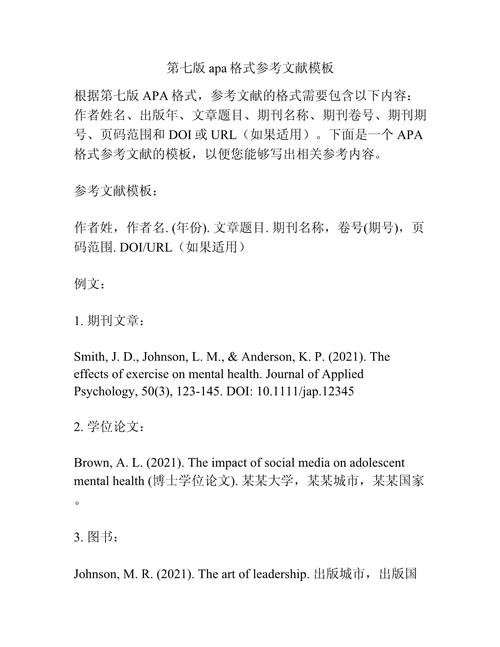
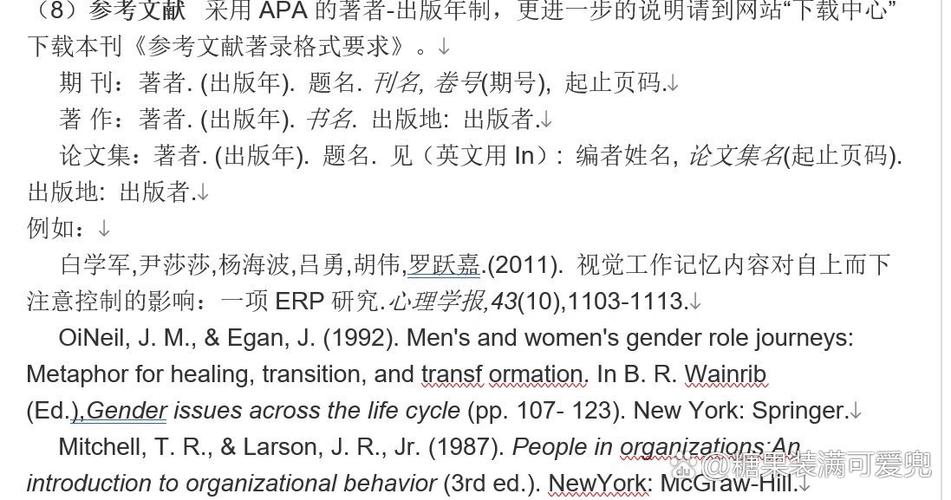
参考文献需另起一页,居中标题“References”,按作者姓氏字母顺序排列,常见文献类型格式如下:
| 文献类型 | 格式示例 |
|---|---|
| 期刊文章 | Author, A. A. (Year). Title of the article. Title of Periodical, volume(issue), page range. https://doi.org/xxxx |
| 图书 | Author, A. A. (Year). Title of work. Publisher. |
| 图书章节 | Author, A. A. (Year). Title of chapter. In Editor B. B. (Ed.), Title of book (pp. xxx-xxx). Publisher. |
| 网页资源 | Author, A. A. (Year, Month Day). Title of work. Site Name. URL |
Baker, M. (2011). In other words: A coursebook on translation (2nd ed.). Routledge.
Wang, D., & Li, C. (2025). Cultural adaptation in translation. Journal of Translation Studies, 12(3), 45-60. https://doi.org/xxxx
图表制作规范
图表需具有自明性,即读者无需阅读正文即可理解内容。
表格
- 表格需按阿拉伯数字连续编号(Table 1, Table 2...),左对齐置于表格上方。
- 表题简洁,斜体,首字母大写(专有名词除外)。“Table 1 Frequency of Translation Strategies Used in Cultural-loaded Words”。
- 表头需明确变量名称与单位,如“Strategy, n (%)”。
- 注释用小写字母标注于表格下方,如“Note. n = number of samples.”
图
- 图需按阿拉伯数字连续编号(Figure 1, Figure 2...),置于图下方。
- 图题斜体,首字母大写,如“Figure 1 Distribution of Translation Strategies”。
- 坐标轴需标注名称与单位,线条清晰,避免使用彩色。
常见注意事项
- 语言简洁:避免冗余表述,使用第三人称客观叙述,减少主观词汇(如“we”“I”)。
- 术语统一:专业术语首次出现需标注英文(如“文化负载词 cultural-loaded words”),全文保持一致。
- 格式细节:页边距2.54厘米,字体为Times New Roman 12号,双倍行距,段落首行缩进0.5英寸。
- 查重与校对:使用Turnitin等工具检测重复率,确保引用格式正确,避免语法错误。
相关问答FAQs
Q1: 翻译研究论文中如何处理多版本参考文献的引用?
A1: 若同一文献有多个版本(如修订版),需在参考文献中注明版本信息,Baker, M. (2011). In other words: A coursebook on translation (2nd ed.). Routledge. 引用时需明确对应版本,避免混淆,若引用同一作者同年多篇文献,需在年份后加字母(如2025a, 2025b),并在参考文献中按字母顺序排列。
Q2: 翻译案例分析类论文如何规范引用原文与译文?
A2: 原文与译文需用引号标注,首次出现注明语言及来源,原文:“春眠不觉晓,处处闻啼鸟。”(李白《春晓》);译文:“In spring, I sleep soundly and never know the dawn; everywhere I hear birds singing.” (Wang, 2025, p. 23),若引用篇幅超过40词,需单独成段并缩进,参考文献需同时标注原文与译文的来源,如Wang, Y. (2025). Selected poems of Li Bai (J. Smith, Trans.). Foreign Languages Press.