IEEE参考文献的核心要素
无论是期刊、会议论文还是其他类型,IEEE参考文献通常包含以下几个核心要素,并遵循特定的标点符号和格式:

- 作者姓名: 格式为
J. K. Author(名字首字母大写,姓氏全拼,首字母大写,中间用点隔开)。 - 使用引号 括起来,标题中的主要单词首字母大写。
- 出版物名称: 使用斜体,主要单词首字母大写。
- 卷号: 使用斜体,后跟冒号 。
- 期号: 用括号 括起来,后跟逗号 ,如果出版物没有卷号,则期号直接跟在出版物名称后,也用括号括起来。
- 页码: 起始页码,后跟连字符 和结束页码,如果文章在线发表且无页码,则使用文章编号 (Article Number)。
- 年份: 后跟逗号 。
- DOI (Digital Object Identifier): 强烈推荐使用,格式为
doi: 10.xxxx/xxxxx。
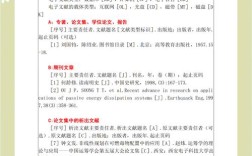
常见文献类型格式示例
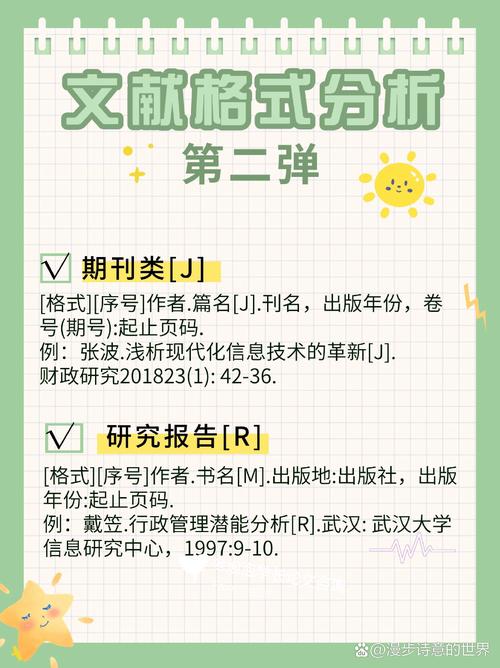
期刊文章
这是最常见的一种类型。
基本格式:
[序号] J. K. Author, "Article Title," *Journal Name*, vol. X, no. Y, pp. a-b, year, doi: 10.xxxx/xxxxx.
示例:
[1] M. B. Priestley, "Non-linear and non-stationary time series analysis," *J. Roy. Statist. Soc. B*, vol. 34, no. 2, pp. 159–176, 1972, doi: 10.1111/j.2517-6161.1972.tb00802.x.
在线优先发表: 如果文章在线发表,尚未分配卷号和期号,格式如下:
格式:
[序号] J. K. Author, "Article Title," *Journal Name*, 2025, doi: 10.xxxx/xxxxx.
示例:
[2] Y. S. Ong, M. H. Lim, and X. Chen, "Memetic computation—Past, present & future," *IEEE Comput. Intell. Mag.*, 2025, doi: 10.1109/MCI.2025.3239589.
会议论文
会议论文通常有明确的会议名称、地点和日期。
基本格式:
[序号] J. K. Author, "Article Title," in *Conference Name*, Location, Country, year, pp. a-b, doi: 10.xxxx/xxxxx.
示例:
[3] G. E. S. P. Box and G. M. Jenkins, "Some recent advances in forecasting and control," in *Proc. 1968 Ann. Conv. Amer. Statist. Assoc.*, Pittsburgh, PA, USA, 1968, pp. 299–307.
书籍
基本格式:
[序号] J. K. Author, *Book Title*, xth ed. City, Country: Publisher, year.
示例:
[4] S. Haykin, *Communication Systems*, 4th ed. New York, NY, USA: John Wiley & Sons, 2001.
书中的某一章
基本格式:
[序号] J. K. Author, "Chapter Title," in *Book Title*, xth ed., Editor(s), Ed. City, Country: Publisher, year, pp. a-b.
示例:
[5] R. C. Dorf and R. H. Bishop, "Introduction to control systems," in *Modern Control Systems*, 12th ed. R. C. Dorf and R. H. Bishop, Eds. Harlow, U.K.: Pearson, 2025, pp. 1–25.
学位论文
基本格式:
[序号] J. K. Author, "Thesis Title," M.S./Ph.D. dissertation, Dept. Name, Univ. Name, City, Country, year.
示例:
[6] A. M. Andrew, "An introduction to digital image processing," Ph.D. dissertation, Dept. Comput. Sci., Univ. Western Australia, Perth, Australia, 2006.
标准
基本格式:
[序号] Standard Title, Standard Number, year.
示例:
[7] IEEE Standard for Verifying Hardware Models, IEEE Std 1076-2025, 2025.
网页或在线资源
基本格式:
[序号] Author(s) (if known), "Title of Webpage," Website Name, [Online]. Available: URL. [Accessed: Month Day, Year].
示例:
[8] Wikipedia, "The Free Encyclopedia," Wikimedia Foundation, Inc., San Francisco, CA, USA, [Online]. Available: https://en.wikipedia.org. [Accessed: Aug. 10, 2025].
在论文正文中引用
当你需要在论文正文中引用参考文献时,使用方括号 [] 里的序号。
-
引用单个文献:
This was first shown by Priestley [1].
-
引用多个文献:
Several studies have confirmed this result [2], [4], [7].
-
连续引用:
The algorithm has been improved over the years [3], [5], [6].
-
作为句子的一部分:
As Ong et al. state in their recent survey on memetic computation [2], ...
实用建议与工具
手动管理参考文献和格式非常耗时且容易出错,强烈建议使用专业的文献管理工具。
使用文献管理软件
- Zotero (免费开源): 非常受欢迎,可以轻松抓取网页信息(如IEEE Xplore, Google Scholar),并生成符合各种格式(包括IEEE)的参考文献列表,安装Zotero Word插件后,可以在Word或LaTeX中直接插入和管理引文。
- Mendeley (免费): 功能与Zotero类似,由Elsevier公司开发,有很好的云同步功能。
- EndNote (付费): 老牌商业软件,功能强大,在学术界有广泛应用。
使用流程:
- 安装文献管理软件(如Zotero)。
- 在IEEE Xplore等数据库找到文章后,点击浏览器插件,文章信息会自动保存到你的Zotero库中。
- 在写作软件(如Word)中,通过插件插入引文,软件会自动在文末生成格式正确的参考文献列表。
LaTeX用户
LaTeX是学术写作的黄金标准,与参考文献管理是天作之合。
- 使用 BibTeX: 这是传统的LaTeX参考文献管理方式,你需要一个
.bib文件来存放所有文献条目,然后在LaTeX文档中使用\bibliographystyle{ieeetr}(IEEE标准样式) 和\bibliography{yourbibfile}来生成参考文献列表。 - 使用 BibLaTeX: 这是更现代、更灵活的方案,配合 Biber 引擎,功能更强大,支持更多样式和选项。
示例 (BibTeX):
在你的 .tex 文件中:
...
\bibliographystyle{ieeetr} % 选择IEEE样式
\bibliography{references} % 你的.bib文件名
在你的 references.bib 文件中:
@article{Priestley1972,
  author={Priestley, M. B.},
  journal={Journal of the Royal Statistical Society. Series B (Methodological)},{Non-linear and non-stationary time series analysis},
  year={1972},
  volume={34},
  number={2},
  pages={159-176},
  doi={10.1111/j.2517-6161.1972.tb00802.x}
}
总结要点
- 核心结构: 作者, "文章标题", 出版物名, vol/issue, 页码, 年份, doi.
- 标点符号: 严格遵守IEEE的标点(逗号、句点、冒号、斜体、引号)。
- 作者格式:
J. K. Author。 - 优先DOI: 如果有DOI,务必包含,这是目前最稳定、最可靠的链接方式。
- 善用工具: 不要手动输入,使用Zotero、Mendeley或LaTeX+BibTeX可以极大提高效率和准确性。
在最终提交前,务必仔细核对目标期刊或会议的“作者指南”(Author Guidelines),因为可能会有一些细微的格式差异。